From Coding to Product Engineering: The 2026 Shift

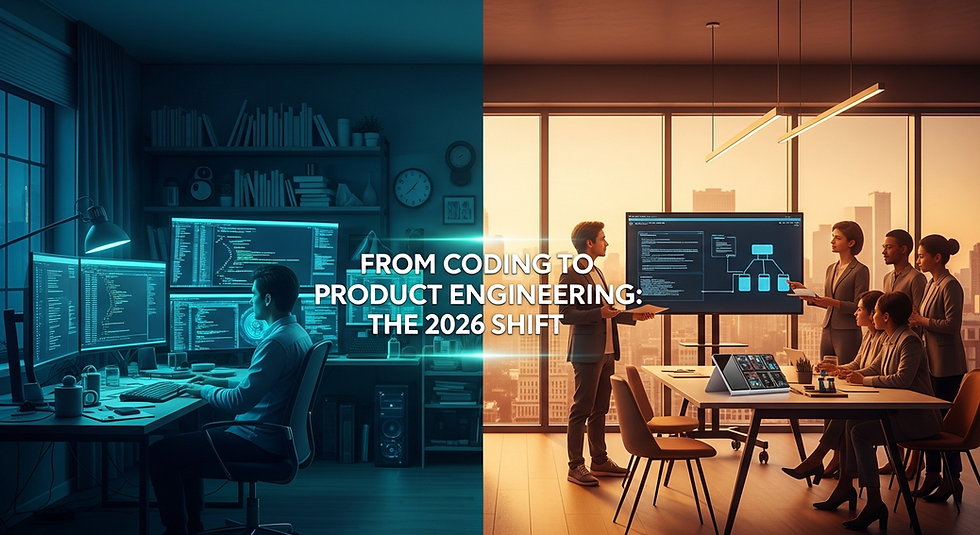
In 2026, the barrier to entry for generating functional code has effectively vanished. Autonomous coding agents now handle the heavy lifting of boilerplate and debugging. Advanced neural IDEs also manage complex refactoring tasks with high precision. The software industry has reached a critical tipping point this year. Technical professionals must now offer more than just the ability to write code. Writing code is no longer a viable competitive advantage for individuals. It is no longer a unique advantage for organizations either. The market now rewards those who bridge gaps between technology and outcomes. Success requires a focus on genuine expertise and real-world judgment.
The 2026 Reality: Syntax is a Commodity
The era of the "pure programmer" has officially ended. We have transitioned into the era of the Product Engineer. In 2024, technical proficiency meant navigating complex software frameworks. Today, specialized AI layers largely manage those same frameworks. Syntax mastery has become a basic commodity available to everyone. The primary challenge in 2026 is not making code work. The real challenge is ensuring the code solves the right problem. We see a growing "Obsolescence Gap" in the current workforce. Developers who focus only on language syntax are falling behind. They are being outperformed by engineers who understand systems architecture. These successful engineers also study user psychology and market-fit dynamics.
The Full-Spectrum Engineering Framework
Technical professionals must adopt a new framework to remain relevant. This framework prioritizes decision logic over the number of keystrokes. It involves three core pillars that every engineer must master.
Contextual Architecture: Engineers must understand how one feature impacts the entire ecosystem. This includes managing server costs and global data privacy compliance. Strict 2026 regulations make this pillar more important than ever.
User-Centric Logic: Engineers must move beyond simple user stories. They must deeply understand the friction points in a customer journey. This requires empathy and a focus on human behavior.
Economic Impact: Technical debt is not just a messy codebase anymore. It is a financial liability that slows down time-to-market. Engineers must communicate this risk to business stakeholders clearly.
Real-World Application: Bridging Strategy and Code
Consider a startup attempting to scale its transaction processing. A traditional coder might only optimize the SQL queries. A Product Engineer analyzes the transaction patterns instead. They might find that 40% of latency comes from redundant API calls. These identity verification calls could be cached locally. This would use a zero-trust architecture to maintain high security.
Imagine a mid-sized retail firm in a hypothetical scenario. They tried to automate inventory using a standard "AI-first" template. The project failed because the developers ignored physical reality. The code was perfect but did not match the human workflow. The warehouse had latency issues that the AI did not see. A successful solution required an assessment of the physical environment. This assessment was necessary before generating any line of code.
Organizations now seek partners who understand specific regional nuances. Businesses in urban hubs look for specialized expertise in the field. They often prioritize mobile app development in Chicago for their projects. This ensures digital products align with local consumer behaviors. It also ensures alignment with specific local infrastructure requirements.
AI Tools and Resources
Cursor & Windsurf: These are next-generation "Agentic IDEs" for modern teams. They understand the entire repository context, not just snippets. Use these for rapid prototyping and maintaining large-scale consistency. They are helpful for engineers who manage complex systems.
Linear B: This is an engineering intelligence platform for team leads. It identifies bottlenecks in the development lifecycle effectively. It helps translate "code activity" into "business value" for stakeholders.
LangSmith: This tool is vital for building LLM-powered applications. It provides the observability needed to debug AI agents. It ensures agents do not hallucinate critical business data. This is essential for maintaining trust in 2026.
Vercel V0: This is a powerful generative UI tool for front-end tasks. It creates functional React components from simple wireframes. Engineers can focus on high-level interaction design instead of CSS.
Risks, Trade-offs, and Limitations
Shifting away from deep coding expertise carries specific risks. There is a danger of "Abstraction Blindness" in modern engineering. An engineer might understand the product but not the failures. They might struggle when low-level AI tools stop working correctly.
The "Black Box" Failure Scenario: A team uses an AI agent to build a module. They use it for a custom encryption task. The module passes every functional test they run. Six months later, a catastrophic data leak occurs. This happened because of an edge case in a library. The team did not manually vet the underlying code.
Warning Signs: A team relies entirely on "Generated" tags for production code. They cannot explain the "why" behind an architectural choice.
Alternative: Always maintain a "Human-in-the-Loop" requirement for security layers. This is also critical for data persistence and privacy layers.
Key Takeaways
Value over Volume: In 2026, your value is the problems you prevent. It is not the number of features you ship.
Master the "Why": Learn when a library is the wrong choice for business. Do not just learn how to use the library.
Cross-Disciplinary Literacy: Gain basic proficiency in UX design and business analytics. These are technical requirements for modern engineering now.
Strategic Regional Focus: Digital products require local context to succeed in 2026. Regional expertise remains a vital part of product development.


Comments